What Happens When We Begin With The Child?


Discovering a Grasshopper on the Roof
Recently at a local early childhood conference, Heather Marshall and Danielle Ficili presented an Introduction to Emergent Curriculum Workshop to their peers. The room was packed with early care teachers eager to learn about our child-led and teacher-framed model of respecting children’s ideas, interests, questions, and lines of inquiry. Heather and Danielle offered rich examples of the purposeful work of our McKendree children, bringing to life the philosophies touted by important theorists: Dewey, Piaget and Vygotsky. They described the principles and practices that support child-centered curriculum:
- Observe the children
- Provision the environment
- Sustain the play
- Enrich the play
- Represent and re-represent the experience
These principles become evident as one tours our center. In the hallways and classrooms there are photos and narratives (documentation) that “tell the story” of children’s learning. Investigations sometimes begin slowly and emerge as children explore – for example: the months’ long Worm Project in the Discoverers Class. Other times, projects begin serendipitously – for example, the Researchers’ new investigation on insects was spurred by the discovery of a beautiful grasshopper on the roof last week.
Often the project topic is not the real story; themes — about movement, power, sensory exploration, transformation, and other developmental schemas (those repetitive patterns and urges in children’s play) — become the driving force in the changing curriculum. The recent explosion of interest in “sticky things” in the Explorers class is a great illustration of the transforming schema. Young children in the sensorimotor phase of learning are creating cognitive structures by exploring, discovering new textures, and acquiring new language to describe these new experiences.
Currently, you will find the Constructivitists (our Pre-K Class) researching Zen Gardens. The children in the Investigators Class are building an interest in dinosaurs — not as a subject of study but more as a representation of “powerful and strong” animals. And, even the older babies are actively engaged in exploration of paint and water. These rich experiences are part of a curriculum designed especially for the children, by the children themselves.

 Obviously unnerved by the theme of her child’s play, she wanted to know how we were guiding and responding to this sort of play at the center.
 We also shared ideas for incorporating more “projection with power” experiences so as not to squelch children’s energy or impulses but to direct and channel them into positive directions. For example, we might ask, “How about we line up some cans and knock them down with tennis balls?’, “Let’s get a hoola hoop and shoot balls through it.” Or, “Who is up for a game of basket ball (using a laundry basket and soft balls)?”
 At McKendree Day Care, we go outdoors for an hour each day unless we are experiencing extreme weather –a high heat index, poor air quality, extreme cold and/or heavy rain or thunderstorms.
 Last year we had an amazing 8 inch snowfall. Heavy snow blanketed our rooftop outdoor classroom, offering us hours of magical play.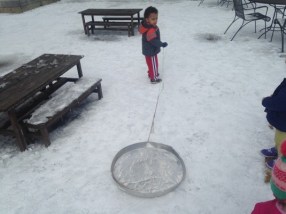


 “Those cards were the icing on the cake!” he said. As he thanked a group of children for their thoughtfulness, Drew immediately said, “I am going to make you another card today!” The act of giving unleashes children’s innate sense of charity and compassion. By giving to others, children receive a huge boost to their own self-esteem. They realize that they can make a difference in someone’s life. What a gift!
 McKendree Daycare